Perspective on the Pandemic and Things to Do Now
The most calming thing I’ve read since the pandemic started is, “You are not a teetering contraption.” While George Will wrote it, he spends most of the article quoting Bill Bryson’s book, The Body, A Guide for Occupants.
Will writes, “Worrying,” wrote Lewis Thomas, “is the most natural and spontaneous of all human functions.” Thomas — physician, philosopher, essayist, administrator (dean of the Yale and New York University medical schools, head of Memorial Sloan Kettering Cancer Center) — thought we worry too much about our health, as though a human being is “a teetering, fallible contraption, always needing watching and patching, always on the verge of flapping to pieces.”
So at this worrisome moment, fill your idle hands with Bill Bryson’s 2019 book, The Body: A Guide for Occupants. It will fill your mind with reasons for believing that you are not flimsy, even though ‘we are just a collection of inert components.’ Including seven billion billion billion (7,000,000,000,000,000,000,000,000,000) atoms, not one of which cares a fig about you. In the time it took to read this far into this sentence, your busy body manufactured 1 million red blood cells that will surge through you every 50 seconds — 150,000 times (a hundred or so miles) before, in about four months, they die and are replaced for the greater good, meaning: for you.
Will concludes: “The brain does not always generate prudent choices, but it did rid the world of the most devastating disease, smallpox, which, Bryson reminds us, ‘infected nearly everyone who was exposed to it and killed about 30 percent of victims’ — about half a billion in the 20th century. This is one of many reasons ‘if you are a seventy-year-old man in America today, you have only a 2 percent chance of dying in the next year. In 1940, that probability was reached at age fifty-six.’
“Globally, the approximately 160,000 people who will die today picked a good time to live. And it is highly probable that the ratio of human worrying about health, to actually worrisome conditions, will continue to enlarge.”
I’ll be 70 in 42 days, so that was reassuring.
When I was young, I could never imagine living this long. I figured the Russians would nuke us at any time. I remember air raid drills at my elementary school with all of us hiding under our wooden desks to protect us from the atomic blast that could be imminent.
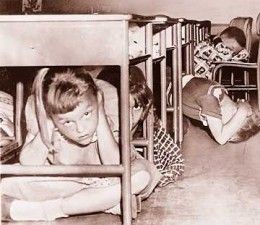 Imagine, going to school and hearing the siren and being told to duck and cover under your wooden desks. Like that was going to help. (Today’s students go through active shooter drills and many fear that fate. Who knows what kind of anxieties they will grow up having?)
I watched JFK’s oval office address when he announced the blockade of Cuba with my sobbing mother. We didn’t know if there would be a family or world to wake up to the next morning.
The article that gave me a brand new perspective.
Earlier today, I was sharing the George Will column with my buddies. Jay Werth read it and, then, sent me this essay from 1948–“On living in the atomic age” by C.S. Lewis.
“In one way we think a great too much of the atomic bomb. “How are we to live in an atomic age?” I am tempted to reply: “Why, as you would have lived in the sixteenth century when the plague visited London almost every year, or as you would have lived in a Viking age when raiders from Scandinavia might land and cut your throat any night; or indeed, as you are already living in an age of cancer, an age of syphilis, an age of paralysis, age of air raids, an age of railway accidents, an age of motor accidents.”
“In other words, do not let us begin by exaggerating the novelty of our situation. Believe me, dear sir or madam, you and all whom you love were already sentenced to death before the atomic bomb was invented: and quite a high percentage of us were going to die in unpleasant ways. We had, indeed, one great advantage over our ancestors—anesthetics; but we have that still. It is perfectly ridiculous to go about whimpering and drawing long faces because the scientists have added one more chance of painful and premature death to a world that already bristled with such chances and in which death itself was not a chance at all, but a certainty.
“This is the first point to be made: and the first action to be taken is to pull ourselves together. If we are all going to be destroyed by an atomic bomb, let that bomb when it comes find us doing sensible and human things—praying, working, teaching, reading, listening to music, bathing the children, playing tennis, chatting to our friends over a pint and a game of darts—not huddled together like frightened sheep and thinking about bombs. They may break our bodies (a microbe can do that), but they need not dominate our minds.”
That’s the perspective I wish I’d had as a second-grader, but I’ll take it now.
My thoughts on the medical system in the United States.
Here’s what is true for me and something you may want to consider, even if you don’t immediately agree with me. I have done a lot of research and reading on the subjects of diet, exercise and health for most of my life. That study ramped up when my wife started her dieting business.
Here’s my take: The United States does not have a health care system. It has a sick care system. If you report with high blood sugar, you’ll get a prescription for insulin. The doctor will not sit and ask about what you’ve been eating for breakfast, lunch and dinner for the past ten or fifteen years.
Your #1 job is to stay out of this sick care system because the third leading cause of death in the United States is hospital-acquired illness and medical mistakes. This is not a well-publicized fact.
But an article in Health Care IT News said this: “It’s a chilling reality – one often overlooked in annual mortality statistics: Preventable medical errors persist as the No. 3 killer in the U.S. – third only to heart disease and cancer – claiming the lives of some 400,000 people each year. At a Senate hearing Thursday, patient safety officials put their best ideas forward on how to solve the crisis, with IT often at the center of discussions.”
Covid-19 reported kills people with compromised immune systems in much higher numbers. What compromises immune systems? Pre-existing, underlying chronic disease.
The most hopeful and helpful article I’ve read came from one of Sarah’s health providers. Dr. Terese in Chicago. Here is her list of 7 proactive things you can do right now to strengthen your immune system so that it will fight the disease instead of hoping there’s a test, a bed or a doctor for you.
“Diet/Lifestyle Recommendations for good health and a strong immune system:
1. Diet – Remove all added sugars, white flours and pastas and foods that are higher glycemic foods. High levels of glucose in your bloodstream can decrease the effectiveness of your immune system in fighting off illness.”
I’ll get back to her list after this aside: Late last week Domino’s announced that it is hiring 10,000 people to help get their pizzas to your door in this pandemic. And of course, all the fast food places are offering drive through service here in Chattanooga. Cook your own food. Sarah’s mother told her seven year old “If you can read you can cook.”
The obesity epidemic is now turning 43 hears old by my count. I start counting in 1977 when George McGovern and his committee issued the Dietary Guidelines for American and said, “We don’t have the luxury of waiting for the research. We have to act.” That’s when we started eating low fat, high carb and blew up.
We are more vulnerable as a nation because 2/3rds of us are overweight or obese and whatever makes you fat, will also make you sick. Diabetes, heart disease, cancer and high blood pressure are all chronic diseases caused by primarily by diet and a little bit of hereditary. You have a lot more control over your health than you’re taking.
Back to Dr Terese and how to strengthen your immune system.
2. Sleep – Sleep deprivation can suppress your immune system. Be sure to get sufficient sleep every night, at least 7 hours/night.
3. Stress – In spite of the never-ending news cycle, try to keep stress levels to a minimum as stress hormones can suppress your immune system. Try implementing stress reducers – exercise, meditation, yoga, laughter – into your daily routine.
4. Hydration – Hydrated cells function more optimally. Water helps to flush out metabolic waste and flushing out this waste will help our immune system function more optimally. Rule of thumb to determine how many ounces of water you need to drink is to divide your weight, in pounds, by half. That number is the number of ounces you should be drinking, at minimum, in water per day.
5. Exercise – exercise gets your lymphatic system flowing, which helps your immune system work more efficiently at fighting infections. Exercise improves circulation, including circulation of antibodies and white blood cells which fight off infections. Even walking can give you these benefits. Moderate exercise is the key as there is evidence that over-training can suppress your immune system.
6. Hand washing/handshaking, etc. – wash your hands!! This is one of the most useful strategies we can all employ to prevent the transmission of viruses. Even hand sanitizer is not as effective, although that is an alternative if soap and water is not available. Do not shake hands, use an elbow bump or jazz hands for a greeting. Avoid touching your face – eyes, nose and mouth!
7. Sinus rinse/Neti pot – cleaning your nasal tissue may decrease a virus’s ability to take hold. This is theoretical and there is no evidence on this with the COVID-19 virus. Xlear is a nasal spray with xylitol and grapefruit seed extract, which have antimicrobial properties.
Sarah and I are walking. I’m adding some jump rope and will figure out a routine. I’m also watching and re-watching some classic movies. Dial M for Murder on Saturday.
It’s hard to take care of business unless you take care of yourself. And what business is out there to be had, you’re probably going to get by offering help and hope to the people who fear losing their businesses and even losing their lives or the lives of loved ones.
We’ll get through this. We’re a lot tougher than we think and as a species we’ve faced down a lot worse diseases and threats than Covid-19. Hope this helps your perspective and that you’ll act on what you can.
Talk soon.
WFH,


Mongolian Beef
There’s no need to order out! This tastes better than any take out I’ve had!