
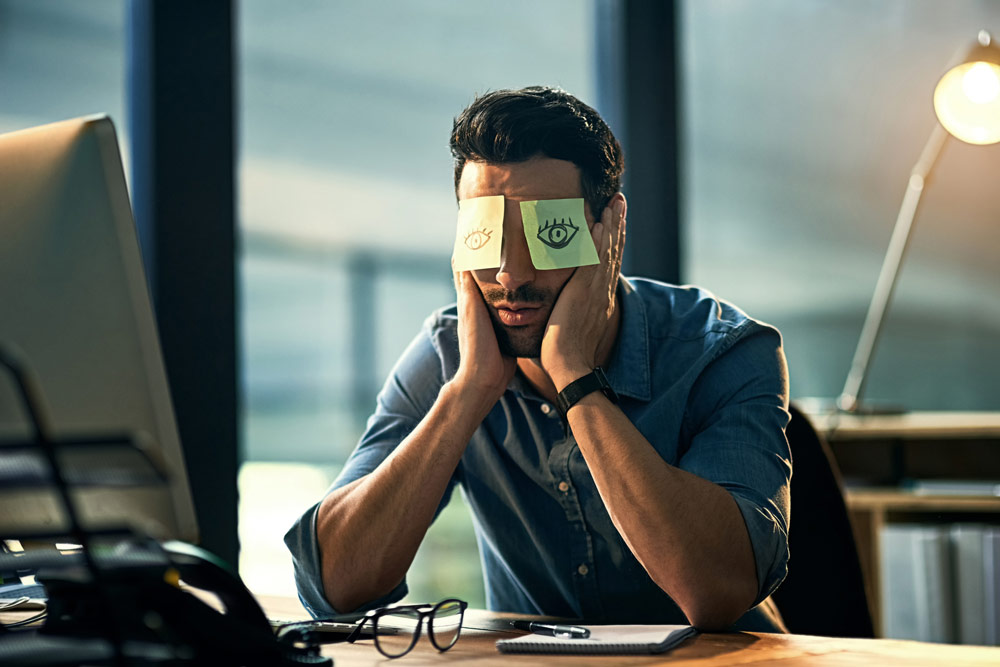
Dying for a Good Night’s Sleep

 Add to favorites


By T.S. Wiley
“I have only a bare working knowledge of the human brain but it’s enough to make me proud to be an American. Your brain has a trillion neurons and every neuron has ten thousand little dendrites. The system of intercommunication is awe-inspiring. It’s like a galaxy that you can hold in your hand, only more complex, more mysterious.”
“Why does this make you proud to be an American?”
“The infant’s brain develops in response to stimuli. We still lead the world in stimuli …”
—Don DeLillo, White Noise
America is home to the brightest and the best and the sickest people in the world. We hold the lead in productivity, eating disorders, SAT scores, diabetes, cutting-edge technology, heart disease and cancer. What do all of those accomplishments have in common?
Well, it’s certainly not a high-fat diet or a lack of exercise.
In our culture, people boast how little fat they eat and how little sleep they can get by on. These two accomplishments are an outward declaration of our ambition and stamina. Our national motto is, “You snooze, You lose.” The word “overtime” is now archaic. In order to apply such a measure to time, we would have to acknowledge a stopping point in the workday. It’s the notion of “quitting time” that’s the real artifact.
We’ve invented sound-bites over the decades to describe the stress of success, from the relatively benign “Type A” personality and “a real Go-Getter” to more disparaging terms like “burnout case” and “success freak.”
Europeans have never called each other names like that.
In this country, we work at least 10 hours a day, try to exercise a few hours a week, and suffer. Deepak says love will keep us together and the government now even agrees we should take a toke or two for medicinal purposes. In this culture, when we’re young, we take drugs to relax; when we’re old, we take drugs to survive.
Has it always been that way? Only for baby boomers.
By the 1940s, postwar America was describing our uniquely driven lifestyle as “keeping up with the Joneses,” “climbing the corporate ladder,” and our successes to the self-congratulatory “good old-fashioned hard work,” as though we were the only people on the globe trying to accomplish anything. To acquire the worldwide lead, Americans have, metaphorically speaking, pulled a century-long “all-nighter.”
We live in cities that never sleep, in a country that rocks 24/7.
It turns out that acquiring the lead in obesity, diabetes, heart disease, and cancer was just a bonus. Of course, golf had to go and those Sunday picnics with the family. It would appear that Americans only have time for only one serious hobby in the year 2010—worrying about dying. Now that maintaining our failing health has usurped whatever time we had left after work for our spouses or children, something as negligible as sleeping is truly unthinkable.
Americans have all but given up sleeping. At most, we get a solid five to six hours a night. We all believe we’re doing fine on that. We set alarms on smart phones, use Starbucks or Red Bull as our drug of choice, and, in some circles, coke, the real thing, not the beverage. The anti-sleeping prescription drug – Provigil has replaced Ritalin in the ivy-covered cloisters of Academia.
We might be tired, but we’re not showing it. Or are we?
According to studies on work-related incompetence, it seems we’re starting to crack. Ten years ago the National Commission on Sleep Disorders Research (NCSDR) estimated that the annual direct cost to employers was $15.9 billion back then, and they were only talking about money. Twenty-eight years ago, the Journal of the American Medical Association published the results of “Project Sleep” from the Association of Sleep Disorders Center declaring that seventy million Americans reported trouble sleeping. That was almost three decades before we all began to have private lap dances with our laptops at two in the morning. The most common disease state was the “disorder of hypersomnia,’ or excessive sleepiness. Forty-two percent (or close to half) of America back in 1982 were, literally, too tired to stay awake.
And, ironically, another 26 percent couldn’t get to sleep or stay asleep. That means for Baby Boomers, like us, we’ve been sleep deprived at least half of our lives. It’s no wonder we’ve missed the possibility that —that alone, could be why we’re all so sick.
So why let sleep loss keep you up nights? Because when you sleep less than you’re meant to, melatonin isn’t the only hormone affected. There are at least 10 different major hormones, as well as many more neurotransmitters in the brain and immune-mitigated cytokines, that go sideways when you don’t sleep enough. Lost melatonin is just the tip of the iceberg, so to speak. It is all the other hormonal shifts resting on the melatonin “timer” that change appetite, fertility and mental and cardiac health that will kill you.
As a nation, we are sick because we don’t sleep. We are fat and diabetic because we don’t sleep. We are dying from cancer and heart disease because we don’t sleep.
An avalanche of peer-reviewed scientific papers supports the conclusion that when we don’t sleep in sync with the hours of daylight and dark and the seasonal variation in light exposure, we fundamentally alter a balance of nature that has been programmed into our physiology since Day One. This cosmic clock is embedded in the physiology of every cell in every living thing that exists. This new approach to illness is humbling and unsettling, but that’s the cost of the truth.
When extended day length, created by artificial light-and-dark cycles, became the norm a short 90 years ago with the widespread use of the light bulb, obesity, diabetes, heart disease and cancer suddenly became the official causes of death on the coroner’s reports, instead of the usual infection or injury common before the advent of the light bulb.
Ever since these diseases began to surface as major killers, the efforts on the part of science and medicine to explain the startling rise in the “diseases of civilization” never bothered to examine any other overwhelming environmental change except diet.
And all these years later, as Americans continue to die in droves, the doctors and the researchers all continue to fish in the same pond.
Maybe it’s time to see the light for what it really is.
The biggest change human beings have lived through in the last ten thousand years happened less than a century ago. There has been no time to adapt to chronic short nights, even if it was possible; which it may not be. Electricity and the widespread use of the light bulb qualify, along with the discovery of fire, the advent of agriculture, as a point of no return in human history. One hundred years ago, in 1910, the average adult was still sleeping approximately ten hours a night. Now the average adult is lucky to get a solid six.
Most of us don’t. Those numbers add up to an extra 1,460 waking hours a year.
In nature, we would sleep 4,370 hours out of a possible 8,760, or almost exactly half of our lives. Ninety years ago, we were down to 3,650 hours. Now we are lucky to get a measly 2,190. If nature keeps a light and dark score, and you can bet she does, that means we only get to live about half as long because we come into this world with just enough hormones for the ones we use in the day light and the ones we need for night. And when you take two days in one by staying up till the wee hours, they come off the end of your, physiologically speaking, as Parkinson’s, Alzheimer’s, some sort of cancer or a heart attack because you run out of hormones.
We may have bought back a little time against injury and infection, the major killers at the turn of the last century with surgery and antibiotics, but think how long we might live if we slept, too. In the 1970s, Americans devoted 27 hours a week to “leisure” time. In the 1990s, we’re down to 15. And we work at least 48 hours a week, compared to 35 for the average worker in the 1970s. Then we had hobbies, we were players of baseball and builders of model ships, members of the garden club and Boy Scout troop leaders. Now, although, the number of hours in a day are approximately the same, the ratio between work and everything else has shifted considerably.
In the forty years since 1970, we’ve found new passions to add to the old duties—exercising, going from doctor to doctor, commuting through ever-increasing traffic, watching 950 channels on TV or the computer, and the most recent time bandits—Email, eBay and Twitter. No wonder there’s almost no time time left to sleep or take care of the children. So why didn’t the guardians of our health look at stress and lack of sleep before they placed the entire blame on food?
Once upon a time we existed in sync with all of the biophysical cycles and rhythms in nature. Now, not only do we control the food supply, but we have pushed back the night and the weather. There is a price for playing God.
And now here comes the bill: the unending artificial light and heat we live in registers as the long days of an eternal summer on that internal sundial because night never falls and winter never comes.
As mammals, we are hardwired to store fat and reproduce when exposed to long light days and then to sleep it off or at the very least starve … for awhile. But now we don’t sleep and we don’t starve, either; at least, we don’t starve for carbohydrates, ever.
That’s why we’re fat and getting fatter. It’s endless August in our bodies and minds.
While fire, with its illumination, extended our day enough to evolutionarily effect intellect and reproduction, limitless electricity may just put us under for good.

The Path to Becoming Non-Diabetic
If someone close to you is struggling with managing their Type 2 diabetes, please tell them to have hope. They are not as powerless as the pharmaceutical industry would have them believe.
Alright I know this is all true and such a great reminder. I’ve found myself going back to the habit I had before PlanZ which was staying up too late . I woke up this morning after sleeping 10 1/2 hours ! I couldn’t believe it, just went to bed early with hubby and couldn’t keep my eyes open . He said to me this morning “ well guess you’ll loose weight today “. I sit down with my first cup of coffee to see what information from PlanZ this morning and it’s from “Anger Management “ Chris . Thank you for this great reminder about how crucial good sleep is for our Health !